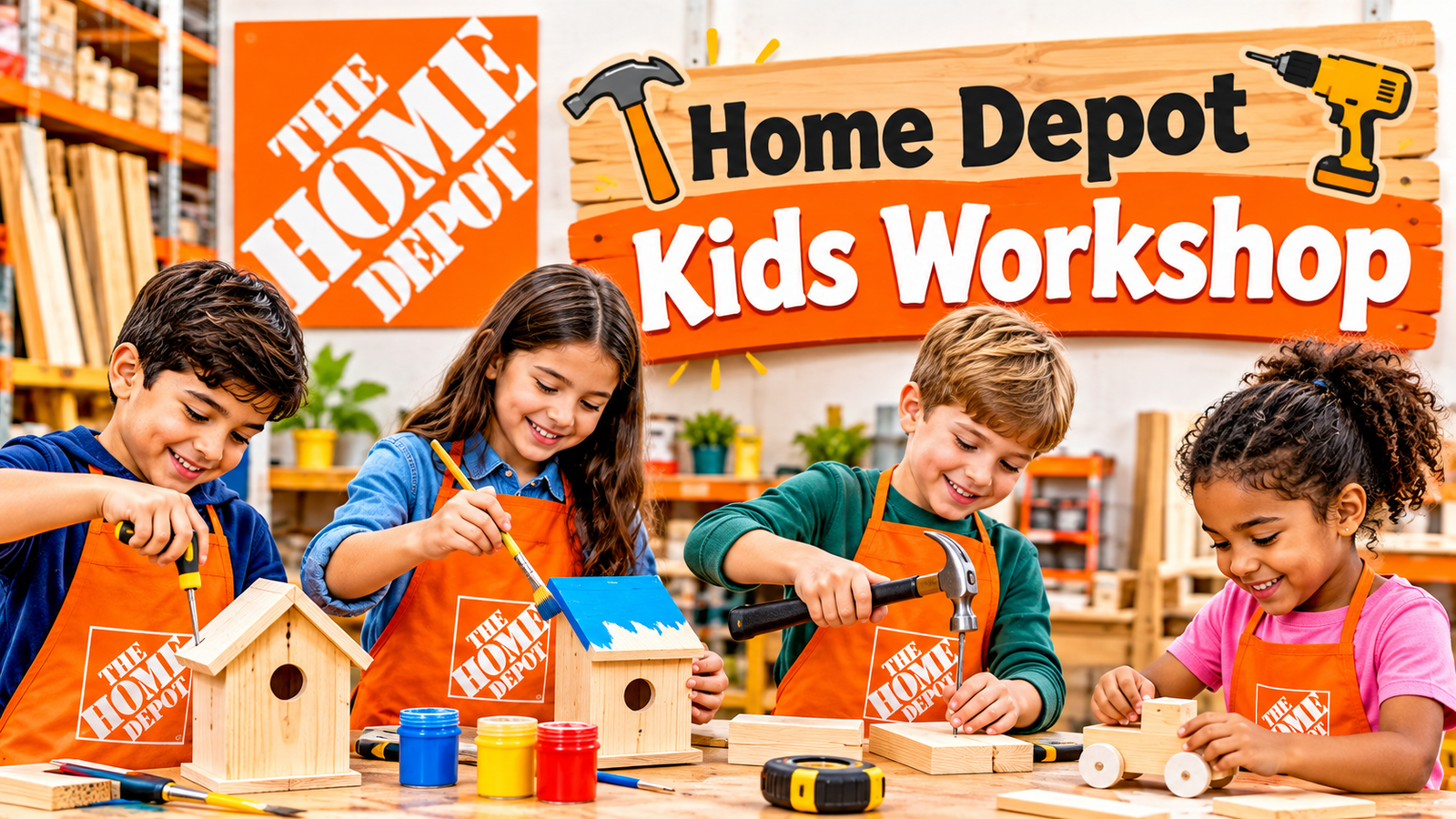
Children learn best when they can explore, experiment, and create something with their own hands. Practical activities give them opportunities to understand how things work while developing confidence and problem-solving abilities. One program that brings these experiences to families is the Home Depot Kids Workshop, a free in-store activity organized by The Home Depot.
The program introduces children to simple do-it-yourself projects in a friendly environment. Instead of only watching demonstrations, participants get the opportunity to build, paint, and complete small projects with guidance from store associates and support from their parents or guardians. These activities make learning enjoyable while introducing children to basic tools, construction concepts, and creative thinking.
What Is the Home Depot Kids Workshop?
The Home Depot Kids Workshop is a free, hands-on learning program designed primarily for children between the ages of 5 and 12. It gives young participants an opportunity to complete simple DIY projects using workshop kits and basic tools.
The program began in 1997 and has developed into a popular family activity at Home Depot stores across the United States and Canada. Workshops traditionally take place on the first Saturday of each month, with a different project introduced regularly.
What children can expect
During a workshop, children receive a project kit containing materials and instructions. They follow the steps to assemble and decorate their project, with help from an accompanying adult when needed.
Depending on the event and available supplies, participants may receive:
- A DIY project kit with building materials.
- A child-sized Home Depot workshop apron.
- A commemorative achievement pin.
- A certificate of completion.
- A finished project to take home.
The program is designed to make basic building activities accessible to children who may have little or no previous experience with tools.
How Does the Home Depot Kids Workshop Work?
The workshop follows a simple structure that allows children to understand each stage of a small building project. Store associates help guide participants, while parents and guardians provide additional assistance.
Step 1: Choose an upcoming workshop
Parents can visit the official Home Depot Kids Workshops webpage to see the available projects and upcoming dates. Each event features a specific project, which may be seasonal, educational, or related to everyday activities.
Step 2: Register online
Families can use the official registration page to select an available workshop and participating store. Registration is recommended because project kits are available while supplies last.
Step 3: Visit the store
Parents and children attend the selected workshop during the scheduled hours. The official program generally begins at 9 a.m. on the first Saturday of the month, although families should check the individual event details.
Step 4: Complete the project
Children follow the instructions, assemble the materials, and decorate their creations. Workshop associates can provide guidance when needed.
Step 5: Take the project home
After completing the activity, children can take their finished project home along with any participation items offered for that event.
Is the Home Depot Kids Workshop Free?
Yes. The official Kids Workshops program is free for participants, while project kits are available as supplies last. Families do not generally need to purchase tools or materials for the scheduled workshop because the required items are provided.
This makes the program an affordable option for parents who want to introduce children to hands-on activities without investing in a separate collection of tools or craft supplies.
Why free workshops are valuable
Free educational activities can make creative learning more accessible to families. Children from different backgrounds can participate in practical experiences, discover new interests, and develop useful skills.
Parents should still check the event’s registration information and participating store details before visiting, since availability and arrangements may vary.
What Age Group Can Participate?
The Home Depot Kids Workshops are primarily designed for children ages 5 to 12. The projects are developed to introduce basic building and creative skills in an age-appropriate way.
Younger children may also be able to participate with additional adult assistance, depending on the project and store arrangements.
Activities for different age groups
Younger participants may enjoy simple assembly tasks, painting, decorating, and identifying different materials. Older children may be more comfortable following multi-step instructions and completing projects that require greater attention to detail.
Parents should consider their child’s abilities and remain involved throughout the activity. Adult supervision is especially important whenever children are using tools or handling small materials.
What Projects Do Children Build?
One of the most exciting parts of the program is the opportunity to work on a different project throughout the year. The monthly themes give children a reason to return and try new activities.
Projects may include decorative items, small vehicles, games, organizers, seasonal crafts, and other creative builds.
For example, the official 2026 schedule includes projects such as a farm planter, keepsake box, goalie game, rocket game, school bus organizer, witch candy box, and dump truck. Upcoming listings can change, so families should consult the official schedule before planning a visit.
Why changing projects matters
Different projects introduce children to different types of challenges. A planter may encourage an interest in gardening, while a small vehicle can introduce basic ideas about shapes, assembly, and movement.
A game project can encourage children to think about design and how objects interact. Seasonal crafts also give families opportunities to connect building activities with celebrations and special occasions.
Educational Benefits of Home Depot Kids Workshops
Hands-on building activities offer more than entertainment. They give children opportunities to practice skills that can support learning in school and everyday life.
1. Encourages creativity
Children can explore colors, shapes, decorations, and design ideas while completing their projects. They learn that there may be different ways to approach a creative task.
2. Develops problem-solving abilities
Following instructions requires children to understand each step and identify what needs to happen next. If a piece does not fit correctly, they can learn to pause, review the instructions, and try again with guidance.
3. Builds confidence
Completing a project gives children a visible result of their effort. Taking a finished creation home can help them feel proud of what they have accomplished.
4. Introduces basic tool skills
The activities may introduce children to simple hand tools, including hammers and screwdrivers. With appropriate adult supervision, they can begin understanding how tools are used safely and responsibly.
5. Improves attention and patience
Building projects often require children to follow instructions in a particular order. This encourages them to focus, work carefully, and avoid rushing through each step.
6. Supports family bonding
Parents and guardians can participate alongside children, making the workshop a shared experience. Working together creates opportunities for conversation, encouragement, and quality family time.
What Skills Can Children Learn?
The workshop introduces practical abilities that can be useful beyond the event itself. Children can develop an early understanding of how objects are assembled and why careful planning matters.
Following instructions
Project kits generally include step-by-step directions. Children learn to read or listen to instructions, recognize different components, and complete tasks in sequence.
Understanding materials
Building activities introduce children to materials and their uses. They may learn how different pieces fit together and why certain materials are suitable for particular projects.
Hand-eye coordination
Assembling pieces, placing components, and decorating finished projects involve coordinated hand movements. These activities give children opportunities to practice fine motor skills.
Basic measurement and mathematics
Some building activities can introduce ideas such as size, shape, position, counting, and simple measurement. Parents can use the project as an opportunity to explain these concepts in everyday language.
Teamwork and communication
When children work with adults or other participants, they practice asking questions, listening to suggestions, and sharing responsibilities.
The Importance of Parent and Guardian Participation
Parents and guardians play an important role in making the workshop a positive experience. The program encourages adults to help children complete their kits rather than leaving young participants to manage every task independently.
Adult involvement also helps maintain a safe environment when children are learning to use tools.
How parents can support children
- Read the project instructions together before starting.
- Explain how each tool should be handled.
- Allow children to complete age-appropriate steps themselves.
- Offer guidance without taking over the entire project.
- Encourage children when they make mistakes.
- Celebrate the finished creation, regardless of how perfect it looks.
The goal is to help children learn through participation. A project does not need to look professionally finished to be a successful learning experience.
How to Register for a Home Depot Kids Workshop
Registration is a straightforward process. Families can check the official website to find upcoming activities and select a participating location.
Registration process
- Visit the official Kids Workshops page at
- Review the upcoming project schedule.
- Select the available workshop and participating store.
- Follow the registration instructions displayed on the website.
- Check the confirmation and event details before visiting.
Registration is recommended, but families should review the official information for the selected store because availability and participation arrangements can vary.
Arriving early is also a good idea, as project kits are offered while supplies last.
Home Depot Kids Workshop Schedule and Timing
The traditional schedule for in-store Kids Workshops is the first Saturday of every month, beginning at 9 a.m. local time. The official website generally lists the available projects and registration information.
The typical workshop window is between 9 a.m. and noon. Individual kits usually take approximately 30 minutes to complete, although the time can vary depending on the project and the child’s experience.
How to stay updated
Parents should check the official workshop page regularly for:
- New monthly project announcements.
- Registration opening dates.
- Participating store information.
- Changes to event timing.
- Availability of project kits.
Checking the schedule before leaving home can help families avoid unnecessary trips and make better plans.
Home Depot Kids Workshop Activities at Home
Families who cannot attend an in-store event can still explore creative DIY activities at home. The Home Depot also provides project guides and instructional videos that introduce children to simple crafts and building ideas.
Some examples include creating a solar oven from a pizza box, building a cardboard playhouse, making a canvas tent, and designing other household craft projects.
Ideas for family DIY activities
Cardboard playhouse: Use large cardboard boxes to create a small playhouse. Children can help decorate the walls, design windows, and choose colors.
Simple bird feeder: With suitable materials and adult supervision, families can create a basic feeder and learn about local birds.
Road trip game box: Make a small activity box with simple games that children can use during family journeys.
Creative painting projects: Encourage children to decorate wooden or cardboard objects using age-appropriate paints and materials.
Parents should choose projects suitable for the child’s age and avoid sharp tools, hazardous materials, or tasks that require adult-level skills.
Home Depot Kids Workshops and STEAM Learning
STEAM stands for Science, Technology, Engineering, Arts, and Mathematics. It combines different areas of learning through practical activities and creative problem-solving.
The Home Depot Kids Workshops connect naturally with several STEAM concepts because children build objects, explore designs, and work through simple construction challenges.
Science: Children can discuss how materials behave and how objects work.
Technology: They can explore how tools and building methods help people complete tasks.
Engineering: Assembling a project introduces basic design, structure, and problem-solving concepts.
Arts: Painting and decorating encourage imagination and creative expression.
Mathematics: Counting pieces, comparing sizes, and understanding shapes introduce basic mathematical ideas.
The Home Depot has also worked with Discovery Education on additional STEAM learning resources through Science Fair Central, giving families and educators ways to extend practical learning beyond the workshop.
Why Families Enjoy the Program
Families appreciate activities that combine entertainment with meaningful learning. The Kids Workshops provide a structured environment where children can create something rather than simply observe a demonstration.
The free participation model also makes the program attractive to parents who want accessible weekend activities.
Children may enjoy collecting workshop projects, pins, and certificates over time. Returning for different monthly activities can help them develop a continuing interest in building, crafting, and learning new skills.
For parents, the experience offers an opportunity to encourage independence while staying involved in their children’s learning.
Conclusion
The Home Depot Kids Workshop gives children an opportunity to explore creativity, basic building skills, and practical problem-solving through free, hands-on activities. Designed primarily for ages 5 to 12, the program introduces young participants to simple DIY projects with guidance from store associates and support from parents or guardians. From assembling small projects to learning about tools and materials, each workshop offers a meaningful experience that combines education and family fun. By checking upcoming schedules and registering through the official website, families can discover new activities and encourage children to enjoy learning through making and creating.
Frequently Asked Questions
1. Is the Home Depot Kids Workshop completely free?
Yes. The official in-store Kids Workshops are free, and the required project materials are provided while supplies last.
2. What age is the Home Depot Kids Workshop for?
The workshops are primarily designed for children between 5 and 12 years old. Younger children may need additional assistance from a parent or guardian.
3. How often does Home Depot organize Kids Workshops?
The traditional schedule is the first Saturday of every month, starting at 9 a.m. local time. Families should check the official website for the latest event details.
4. Do parents need to bring tools or materials?
No. The workshop provides the materials and tools required for the scheduled project. Parents or guardians should accompany children and help them complete the activity.
5. How can I register for a Home Depot Kids Workshop?
Visit the official Kids Workshops webpage, select an upcoming event and participating store, and follow the registration instructions provided online.