


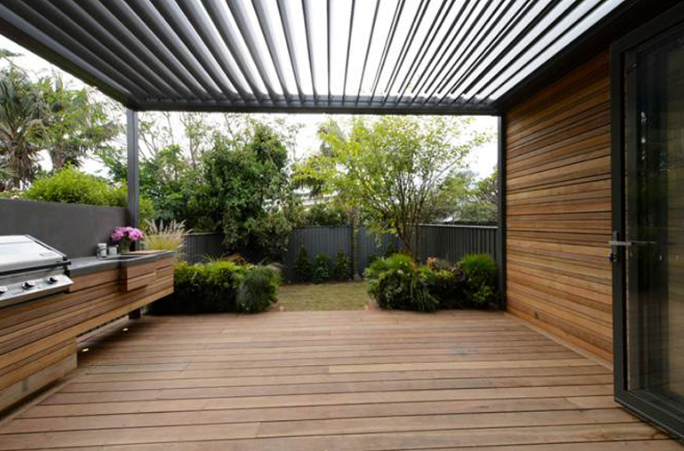
Sydney’s outdoor lifestyle is non-negotiable. Residents do not simply want a backyard — they want a liveable extension of their home that performs in January heat and July drizzle alike. Yet most standard patio covers and pergolas force a frustrating choice: sun or shelter, open air or weatherproofing. That compromise is exactly what Louvre roof systems in Sydney are designed to eliminate, and the results speak for themselves.
Fixed Roofs Are Quietly Failing Homeowners
Walk through any established Sydney suburb, and you will find the same story repeated — a timber pergola that looked wonderful on installation day, now bleached, warped, and shedding splinters. Fixed patio structures cannot adapt, and Sydney’s climate does not forgive rigidity. The UV index here regularly sits in the extreme range, and coastal salt air accelerates corrosion on anything not specifically engineered to resist it. Homeowners are not replacing their old structures out of preference for novelty. They are replacing them because fixed roofing consistently underperforms in the very conditions it was meant to handle.
The Blade Angle Changes Everything
What separates a Louvre system from every other outdoor roofing product is that single mechanical detail — the rotating blade. At roughly fifteen degrees of tilt, rainwater channels directly into the frame’s internal drainage system rather than pooling or dripping. At forty-five degrees, cross-ventilation increases noticeably whilst direct sun is cut without making the space feel enclosed. At ninety degrees, the space opens entirely to the sky. This is not marketing language — it is the practical consequence of a well-engineered pivot mechanism that most homeowners only fully appreciate once they stop squinting through lunch on a westerly-facing deck.
Sydney’s West-Facing Decks Have a Specific Problem
Afternoon sun on a west-facing outdoor area in Sydney can render the space completely unusable between roughly two and six in the evening — ironically, the hours most homeowners actually want to use it. Solid roofing merely shifts the problem by creating a hot, shadowed box that traps radiant heat from surrounding surfaces. Louvre roof systems allow blades to be angled specifically to cut western sun whilst keeping airflow moving, which prevents that suffocating heat build-up that solid covers are notorious for. For west-facing properties particularly, this is not a luxury upgrade — it is a functional necessity.
Motorisation Is More Practical Than It Sounds
Many homeowners initially view motorised louvre systems as an indulgence. That perception tends to shift the first time Sydney’s weather changes mid-afternoon, which it does with remarkable frequency. A manual system requires someone to physically adjust the blades — sometimes repeatedly across a single afternoon. A motorised system, particularly one integrated with a rain sensor, closes automatically when precipitation is detected. Guests stay dry, cushions stay dry, and nobody scrambles across the patio mid-sentence. Louvre roof systems with integrated sensors have moved from premium specification to near-standard offering for this precise reason.
Aluminium’s Role Is Structural, Not Just Aesthetic
There is a tendency to treat the choice of aluminium in louvre systems as a visual decision — the sleek, modern finish suits contemporary architecture. The structural case, however, is equally strong. Aluminium carries an exceptional strength-to-weight ratio, which matters because louvre roofs span significant distances without intermediate supports. That unobstructed span is what makes the space feel genuinely open rather than cluttered with posts. Powder coating applied over aluminium also creates a finish that resists chalking and colour fade in ways that paint over timber or steel simply cannot match over a Sydney decade of UV exposure and salt-laden air.
Conclusion
The shift towards Louvre roof systems in Sydney is not a design trend — it is a practical correction. Homeowners have spent years discovering that standard patio covers are compromises dressed up as solutions. A Louvre system addresses the actual variables of Sydney outdoor living: unpredictable afternoon weather, punishing western sun, humid summers, and the desire for a space that works without constant adjustment. Properties with well-installed louvre systems tend to command genuine interest at sale time, not because buyers are impressed by the mechanism, but because they immediately picture themselves using the space — which is ultimately what any good outdoor structure should achieve