


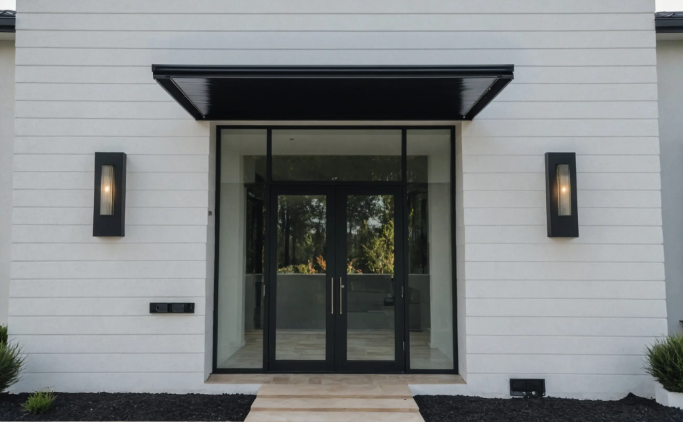
Most people only think about a door awning after standing in the rain, fumbling with their keys, getting soaked through before they even get inside. By then, the case for fitting one is already made. But the real reasons to install one go much further than that single frustrating moment — and most of them never make it into any product description.
The Threshold Problem Nobody Talks About
There is a specific zone right at the entrance of a home that almost nobody waterproofs properly. The threshold strip, the bottom seal of the door, the narrow gap between the door frame and the brickwork — all of these sit exposed to wind-driven rain that does not fall straight down, it comes in sideways. An awning does not just keep rain off your head while you find your keys. It creates a dry buffer zone directly in front of the door, which stops water being pushed horizontally into those exact weak points. That is how entrance damp actually begins in many homes — not through dramatic flooding, but through persistent lateral moisture finding its way into small gaps. An awning interrupts that process at the source.
Timber Doors Age Badly Without Cover
Timber expands when it absorbs moisture and contracts when it dries out. That movement is unavoidable — but a door that gets soaked in the morning and then baked by afternoon sun is cycling through those extremes more aggressively than it should. That repeated stress is what splits paint, opens joints, and eventually warps a door until it no longer seals the frame properly. Draughts follow. Then heating bills climb. A door awning interrupts that cycle by keeping the door surface drier across the seasons. The door stays more dimensionally stable, the fitting stays tighter, and the whole entrance performs better for longer. It is not an aesthetic consideration — it is structural.
North-Facing Entrances Face a Specific Challenge
A north-facing entrance never gets direct sun. That sounds unremarkable until you realise it also means it rarely dries out properly between rain showers. Moss, algae, and dark mould colonise stonework and door frames on shaded elevations much faster than most homeowners expect. An awning reduces the surface moisture that feeds those organisms. That matters beyond appearances — masonry that stays persistently damp begins losing integrity at the mortar joints long before any visible cracking appears. Fitting an awning over a north-facing entrance is one of the more overlooked forms of building maintenance available to a homeowner.
It Changes How the Entrance Gets Used
A covered entrance — even a relatively shallow one — creates a natural transitional space. People remove muddy footwear there rather than tracking it inside. Deliveries get left somewhere protected rather than sitting in open rain. Visitors wait without getting wet. None of these things tend to happen without a covered area to prompt them. A door awning is, in this sense, a behavioural fixture as much as a physical one. The entrance functions differently when there is shelter above it, and those small daily differences add up to genuine improvements in how a home feels to live in.
Glass Panels and the Condensation Issue
Doors fitted with glass panels or adjacent sidelights carry a condensation problem that rarely comes up in conversation. During cold nights, the glass chills down and collects moisture by morning. That moisture runs to the base of the glass and sits right at the seal line — which is precisely where seal failure tends to begin. The sun then hits the glass and heats it rapidly, creating a sharp temperature swing that accelerates the deterioration. Shading the glass moderates that swing. An awning positioned above the entrance does this without any ongoing effort, simply by intercepting the direct sun before it reaches the glass.
Conclusion
A door awning works through accumulation rather than through any single dramatic effect. It keeps the threshold dry, stabilises the door against moisture cycling, slows biological growth on shaded masonry, and changes the practical behaviour of everyone who uses the entrance. The front door takes more concentrated punishment than almost any other part of a home — rain, sun, temperature shifts, and constant physical use all meet in one small area. Addressing that with a properly fitted awning is, quietly, one of the more sensible things a homeowner can do.